
Open Weights, Many Winners
AI is moving from a duopoly to a multipolar world of many winners


This will be remembered as the summer of open models.
Every week we are seeing new open weights models nearing and in some cases surpassing frontier level performance: Kimi K3, GLM 5.2, DeepSeek V4 Pro and Qwen3-Coder are all topping leaderboards and competing with the top Claude and GPT models, often at a fraction of the cost. Even US companies are getting into the open models game, with Mira Murati's Thinking Machines shipping Inkling, and Poolside dropping Laguna S 2.1, which it bills as the West’s most capable open-weight model.
Which has everyone asking the same question: can OpenAI and Anthropic survive it?
Those guys will be fine.
They’ll keep shipping frontier models for the hardest tasks, cheaper models over time, and the apps, features, and hardware around them. It’s the wrong question.
The right one is who else wins when frontier-grade intelligence becomes cheap and abundant.
Because that's the real shift. Open weights are turning the AI market from a two-horse race into a multipolar world with durable winners at every layer of the stack. But multipolar means many winners, not everyone. Value still flows to whoever owns a position that compounds — and gets competed away from everyone who doesn't. Open weights didn't hand out prizes. They opened up a lot more seats. You still have to bring something to claim one.
To us, there are three main winners: compute (in the short-term), routing and inference (in the medium term), and owners of intelligence in the long-term.
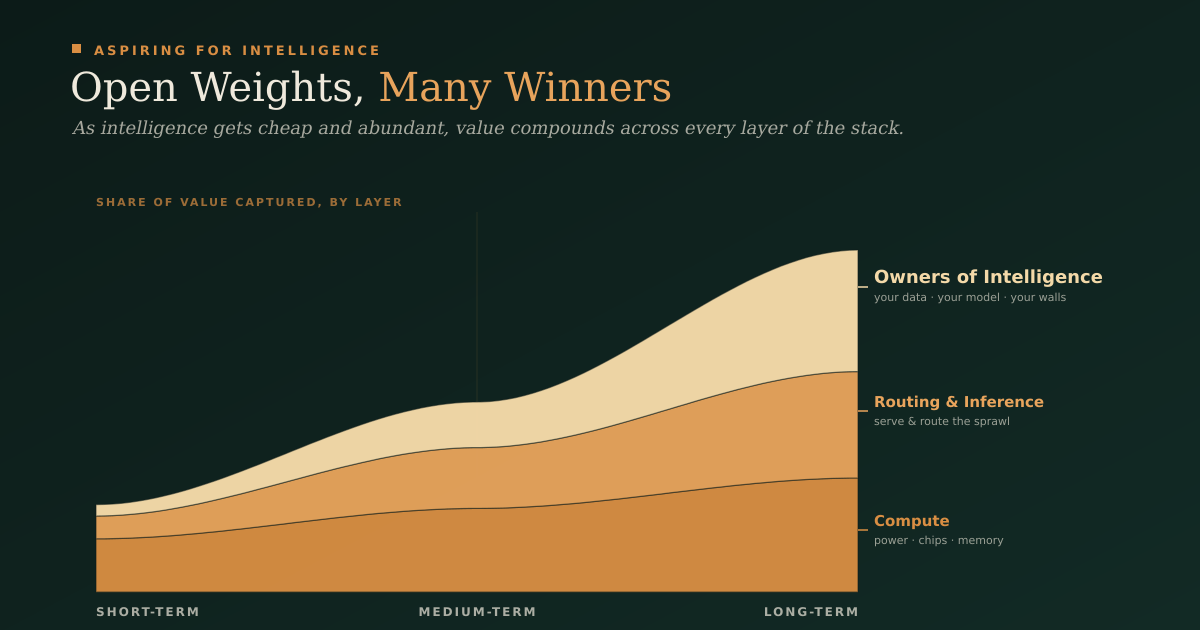
Short-term winner: Compute
Compute didn’t need more demand. It’s getting it anyway.
Yes, open models are cheaper per token. But the number of tokens is exploding — partly because open models are often less efficient, and mostly because cheap intelligence gets used far more. As Fireworks CEO Lin Qiao put it: a 10x drop in cost drives a 100x explosion in usage.
We are already seeing this unfold in real-time. Kimi K3 suspended new subscriptions within 48 hours of launch after overwhelming demand overwhelmed capacity (“our GPUs are feeling it”). Z.ai is moving down the stack and building a 1GW data center to serve its GLM models.
It won’t last forever, particularly as smaller open models increasingly run on local, cheaper hardware. But in the near term, the strain on compute (memory, power, chips, etc.) will only continue to skyrocket.
Medium-term winners: Routing & Inference
As the model layer fragments into hundreds of interchangeable options, someone has to turn raw weights into fast, reliable, affordable endpoints, and route intelligently between them.
In the wake of OpenRouter fielding a potential $10B (!) acquisition offer from Stripe, several leading AI companies are releasing routing engines, from Ramp to Cursor. We’ve also been impressed with growing standalone routers like Requesty, which also act as AI gateways. Demand for routers is compounding, driven by three main factors: i) access to the latest models, ii) cost optimization for the right task, and iii) ensuring adequate security and guardrails in using a wide range of models.
And inference providers like Fireworks, Baseten, Together.ai will do exceptionally well. An open model is just a file until someone makes it run well. Turning frontier-scale weights into fast, cheap tokens is real engineering — throughput optimization, kernel-level tuning, autoscaling — and it's exactly the work no enterprise wants to do itself.
Long-term winners: Developers & Owners of Intelligence
This is the big one.
For the first time, a serious enterprise can bring a frontier-class model in-house — fine-tune it on proprietary data, run it in its own environment, under its own security and governance — without renting from a lab on the lab’s terms.
That’s a profound shift. Companies get to own their intelligence — a model shaped by their data, sitting behind their walls — instead of leasing it. And it connects to the oldest truth in this business: the durable moat was never the model. It’s the proprietary data loop you run through it. Open weights just made that loop dramatically cheaper to own.
As we wrote about previously, the advantage every enterprise already has is the data, judgment, and know-how inside its own four walls. Open weights finally let them turn that into intelligence they control.
Who doesn’t win?
Not everyone will be a winner.
A multipolar world doesn’t benefit everyone, especially those whose assets get commoditized: pure API resellers, thin wrappers with no proprietary data, businesses whose entire moat was privileged access to a model anyone can now download for free. Cheaper inputs only help you if you own something downstream of them.
In the end, models will look like electricity - the fuel that powers everything above it, but a commoditized product that captures little value on its own.
The duopoly is over. What replaces it is a multipolar world with winners at every layer. And the biggest winners will be the developers and enterprises that choose to OWN their intelligence — not merely rent it.