
Own the Data Loop
The real AI moat isn't the model or the harness, but the data flywheel you build on both


A few weeks ago we argued that the era of frontier-model dominance is ending — the value in AI is migrating from the raw model to the harness around it, catalyzed by the rapid progress in open-source and open weights models. But we want to take it a step further: the real moat isn't the model, and it's not just the harness either. It's the data you compound on top of both.
That tension is already playing out publicly. In CNBC appearances this summer, Palantir CEO Alex Karp has hit the same note: enterprises are "unhappy" with the frontier labs, tired of paying for tokens that create "no value," and increasingly worried the labs will end up with their "alpha" - the proprietary edge that makes their business their business. "Something has gone completely wrong," he said on a recent Squawk Box appearance. Karp has an obvious commercial incentive here — Palantir sells the alternative — but the discomfort he's naming is real, and it's not only his customers who feel it.
theCUBE Research has been tracking this same fault line and gave it a name: "data communism" — everyone renting the same intelligence from the same few providers, and therefore owning none of it. Their proposed counter is "data capitalism," where proprietary advantage stays exclusive to the enterprise.
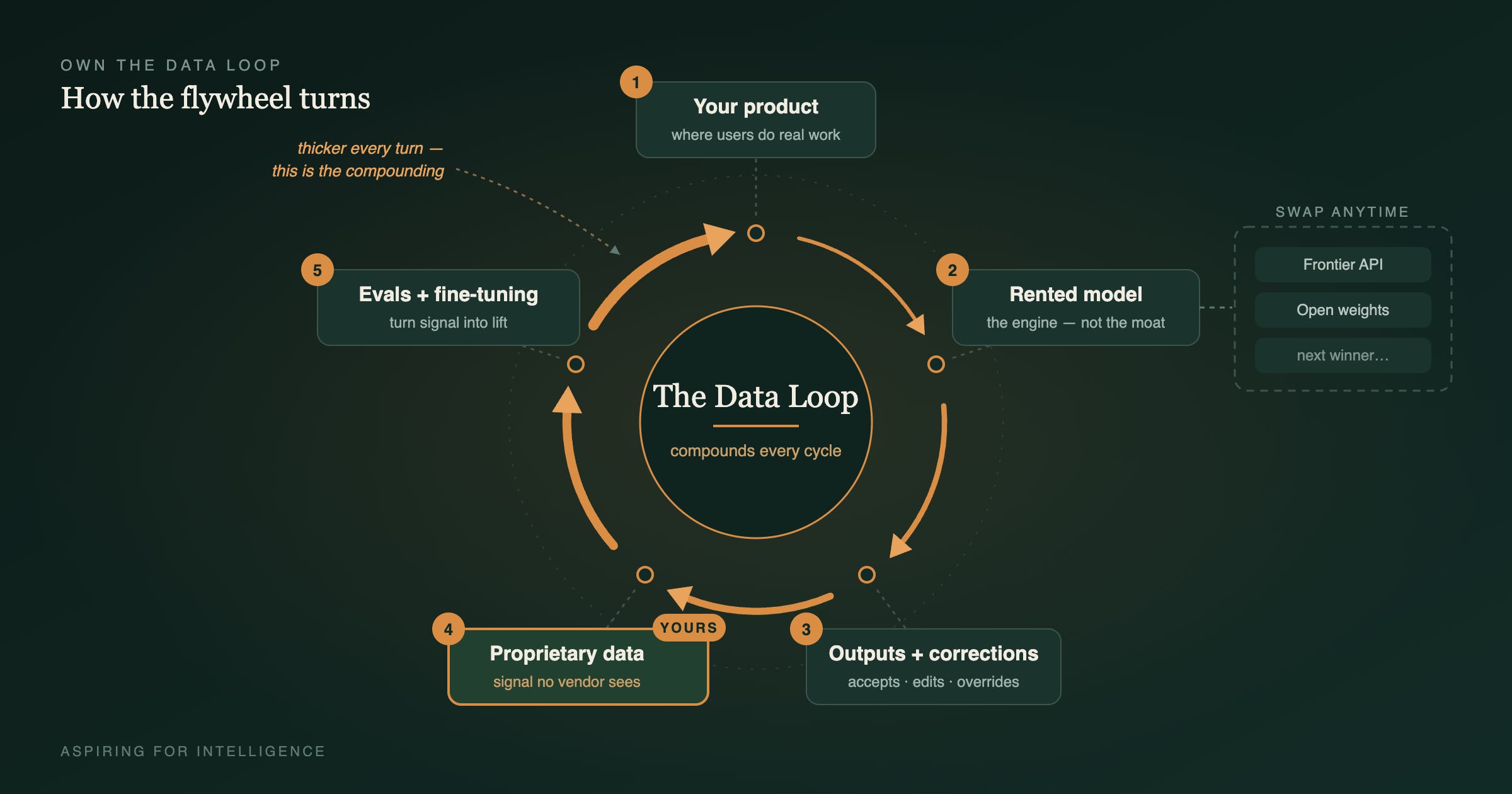
We fully agree that data capitalism (or the data flywheel) is the correct approach, and we take that a layer deeper. While enterprise buyers should be protecting their operating intelligence from vendors, AI-native companies can build defensibility in the first place by embracing data capitalism. How? Not by avoiding frontier models, but by treating them as a rented engine underneath a data loop the company owns outright: one that compounds with every interaction and survives no matter which model wins this quarter.
Open source is what makes that buildable now.
Frontier models are for exploration
The debate we hear today usually gets framed as binary: expensive frontier models OR cheap open-source models. We think the best will leverage both. They use frontier models where they’re actually worth it and that is typically when exploring at the edge of what’s possible, to find out if a capability exists at all, or on the hardest slice of requests (like difficult coding tasks).
Cursor is a very clean example. They built product-market fit on top of frontier models like Claude for hard reasoning and agentic coding. But Tab, their high-volume autocomplete, runs on Fusion — a model they trained in-house, because autocomplete needs to return in milliseconds thousands of times a day, and a fine-tuned model beats a general one on that specific job. Frontier models got them to PMF, but the custom model is what let them scale it at unit economics and latency that made sense.
Frontier models are the easiest way to find out fast if you've actually got something customers want. They're some of the most performant models out there, and you don't have to think about fine-tuning, maintaining, or securing your own — someone else handles all of that. They're also innovating at warp speed, so early on you can focus on solving your customer's problem instead of babysitting the model underneath it. That's the right trade to make first. But it doesn't scale at the current costs, and it doesn’t get you any closer to owning your own data loop.
Fine-tuned models win at scale
Once you’re past PMF and actually scaling, smaller fine-tuned models running on open source start winning on latency, cost, and data — and not every agentic company needs to run on the cutting edge to work.
On latency, a model fine-tuned on your task, running on your own infrastructure, is often faster and more accurate than a general-purpose model reasoning its way to the same answer from scratch. In agentic systems, where one user action can trigger dozens of model calls, every hundred milliseconds compounds — the gap between a 2 second and a 92 millisecond response is the gap between an assistant that feels alive and one that feels broken. Decagon holds <400ms p95 latency and roughly 6x lower cost per turn than closed models by fine-tuning smaller models for voice and support. As NVIDIA put it, routing every step of an agent through a giant model is “architectural malpractice” — you’re paying to send a 2KB message through a model that also knows Shakespeare and Python.
Costs follows the same logic but compounds differently once you own the model. A fine-tuned model has a mostly fixed cost that gets cheaper per request as volume grows, instead of a per-token bill that scales with usage no matter how repetitive the task is. Fine-tuned small models can run at $3 per million requests against $6,241 for Claude Opus, while still landing in the top three of eight models tested (Distil Labs). Sully.ai cut inference costs 90% moving clinical workflows to fine-tuned open models.
The catch is that running all of this on open source and fine-tuning on your own takes real experience, and it isn’t free. Running your own models means owning security and compliance for how your proprietary data is stored and trained. This is a much bigger surface than calling an API, and there aren’t many people yet who know how to fine-tune, serve, and maintain these models well. That’s a real constraint we are monitoring today.
Ultimately, the data flywheel is the moat
Here’s how it closes the loop. A small model beats a frontier model on your task because it’s fine-tuned on your data. Running it in production generates more data — corrections, edge cases, reasoning traces — which fuels the next round of fine-tuning. Cost efficiency funds scale, scale generates data, data sharpens the model, a sharper model deepens the moat. That’s the flywheel. That’s data capitalism.
Open source is what lets you own that flywheel end to end. You can fine-tune a closed model too — OpenAI and Anthropic both sell that. But you’re still renting compute, metered per token, exposed to their pricing and their kill switch. Open weights let you bring the whole loop in-house: fine-tuning, serving, cost, deployment. That’s the difference between improving a rental and owning an asset.