


For years, the conventional wisdom was simple: models are commoditizing, so enterprises shouldn’t bother training their own.
Why do the difficult and costly work of building a model when you can buy frontier intelligence from Anthropic or OpenAI through an API? Instead, enterprises should focus their energy on the layers where they actually differentiate: applications, proprietary data, and workflows.
What if that advice had it backwards?
Cheap, abundant base intelligence was supposed to make building your own model pointless. It did the opposite. As increasingly capable open-weight models become readily available, and post-training becomes a known discipline rather than a dark art, standing up your own model starts looking less like founding a lab and more like standing up a data platform.
Look at the trends that involved with several legal firms over the summer:
Thomson Reuters shipped a model, named Thomson, that it says performed competitively with the strongest frontier models on the market, including Claude Opus 4.8, and ahead of GPT-5.5, Claude Sonnet 5, and Gemini 3.1 Pro on a mix of legal and general benchmarks. They didn’t pretrain it. They took an open-source base and ran mid-training and post-training on decades of authoritative content from Westlaw, Practical Law, Checkpoint, and Reuters, with hundreds of subject matter experts who evaluated outputs, identified failure modes, and validated that the model reasons the way legal professionals actually work. And they’ve claimed to have used only less than 10% of Thomson Reuters content so far!
Morgan & Morgan, the largest personal injury firm in the country, last week stated it is committing $1 billion to artificial intelligence over the next decade, having already spent $300 million since 2021 on an in-house platform called MX2 using frontier models as a base. That’s a law firm putting about 4% of revenue into its own AI stack, and planning to license the result to other firms. John Morgan’s line was roughly that the winners won’t be the firms that license an AI tool, they’ll be the firms whose lawyers teach the model.
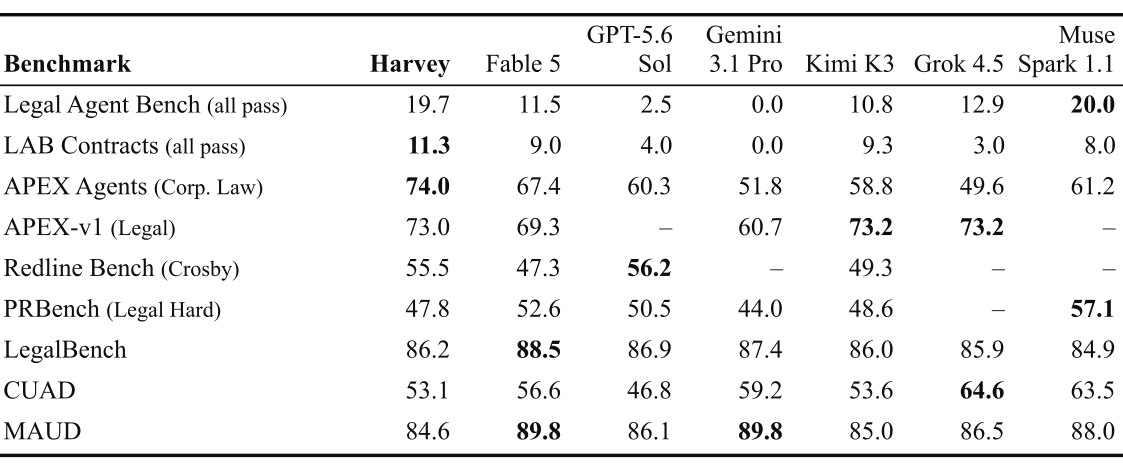
And now Harvey, perhaps the most well-known legal AI workflow tool out there, has been making the transition from “app to model” through Tenet, their first “post-trained open weight model”.
Harvey Tenet is a Kimi K3 base that we post-trained together with Fireworks research for long-horizon legal work. In addition, it incorporates harness improvements to make training and task execution more effective. Our initial work shows promising results for both performance and cost-efficiency.
And this isn’t just happening in legal. For example Travelers recently announced TravelersLLM, a proprietary model trained on millions of company documents for insurance-specific tasks across underwriting, research, and internal workflows. The company says the model has outperformed commercial models across tens of thousands of insurance questions, while also improving speed and cost.
Different industries, but the same basic playbook: start with increasingly abundant base intelligence, combine it with proprietary data and expert knowledge, and train something that understands the business in a way a general-purpose model does not.
So what’s going on?
The mistake may have been treating “build” versus “buy” as a binary choice.
It’s becoming easier than ever for an enterprise to turn into a “neo neo lab”. The goal isn’t to build frontier intelligence from scratch like Anthropic, OpenAI, or Thinking Machines. It is to take increasingly abundant base intelligence and systematically turn proprietary data, expert judgment, workflows, and feedback loops into proprietary intelligence (we wrote about “owning your data loops” previously here).
In other words, the “lab” is less about pretraining and more about owning the process that turns what an organization knows into how a model behaves. The result is something different from both a traditional enterprise AI application and a frontier lab.
Call it the neo neo lab.
And “lab” here doesn’t necessarily mean massive amounts of pretraining. It might mean:
Proprietary mid/post-training
Domain-specific models
Continuous eval infrastructure
Synthetic data generation
Distillation from frontier models
Reinforcement from internal workflows
Proprietary tool-use / agent training
Routing between proprietary + frontier models
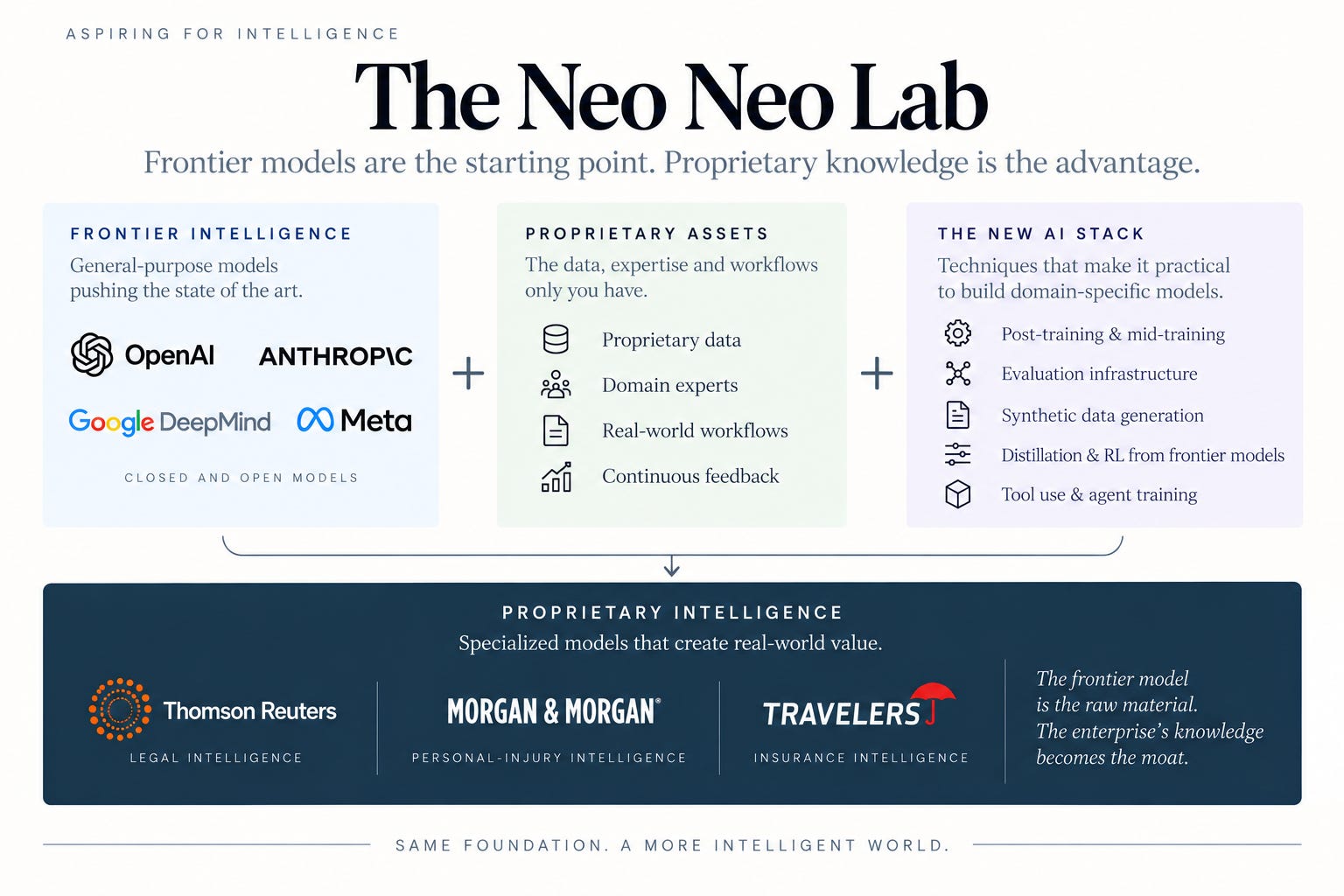
Legal may simply be an early proving ground for the model.
Why legal first? Because legal has the right ingredients: enormous proprietary text, expensive experts whose judgment is the product, and millions of repetitive, high-stakes workflows that generate a training signal every day. TR’s SEC filings describe a corpus of 1.9 billion documents with 36 million editorial enhancements on top. If you’re sitting on something like that, a frontier model is your floor, not your ceiling.
But legal won’t be the only sector in which we see classic “enterprises” turning into a version of the neo-lab. Companies that have access to unique data, domain expertise, repetitive workflows, and real scale will start to build, post-train, and expose specialized models. We expect to see this play out in healthcare, insurance, financial services, and industrial engineering.
So where does this end up?
The last generation of enterprise software was built around proprietary data and workflows. The next may be built around proprietary intelligence derived from them.
The frontier labs will continue pushing the ceiling of general intelligence. But increasingly, enterprises may take that intelligence and teach it what only they know.
Not every company should build its own model. Most probably shouldn’t.
But for companies sitting on enough proprietary data, expert judgment, workflow volume, and distribution, the question may no longer be whether they should simply CONSUME intelligence. It may be whether they have the raw materials to PRODUCE proprietary intelligence of their own.
I agree that this is one of several mega-trends that we will see play out over the next few years. Lots of others like JLL and Kirkland. Going first has advantages. I think that the cost of building these Neo Neo's will greatly decrease over time. And of course, there is the sovereign aspect—hosting your own model and data can really build a moat.